THE ART OF BEING HUMAN
AI, Photography, Music, and What We’re Losing Along the Way
I’ve been thinking about writing this for quite some time. And I’ll warn you right now, I might ruffle a few feathers with this one. But that’s alright. I’ve never been particularly good at keeping my mouth shut when something matters to me. And this matters to me. A lot.
Artificial intelligence. Two words that seem to be finding their way into damn near every conversation these days. It’s everywhere. Photography, music, writing, movies, advertising, graphic design. You name it, somebody somewhere is figuring out how to have a computer do it faster, cheaper, and with as little human involvement as possible. And as a professional photographer, I’ll tell you something. It scares the hell out of me. And quite frankly, it pisses me off.
Not because I’m afraid of technology. Not because I’m some old stubborn bastard who refuses to change with the times. I’ve embraced technology throughout my career. Digital cameras, editing software, new equipment, new techniques. I’ve spent countless hours learning how to use these tools to become better at what I do.
But somewhere along the way, we crossed a line. We went from using technology to help us create something, to using technology to create something instead of us. And those are two very different things.
Let me tell you something about photography. People see a photograph. Maybe it’s a wolf standing in the snow in Yellowstone. Maybe it’s the first light hitting the Tetons. Maybe it’s a storm rolling across the desert in Utah. They see the finished image. What they don’t see is everything that went into making it.
They don’t see the thousands of miles behind the windshield, the gas stations at three in the morning, the cheap hotel rooms, or the mornings when the alarm goes off at some ungodly hour and you seriously question every life decision you’ve ever made. They don’t see the freezing temperatures, the blistering heat, the rain, the mud, or the snow. They don’t see the hours spent sitting in one spot waiting for an animal that may never show up, or the days spent chasing light that never quite cooperates.
They don’t see the injuries, the exhaustion, the missed meals, the busted equipment, or the money spent getting somewhere only to come home with absolutely nothing worth showing. And believe me, I’ve had plenty of those trips. I’ve stood in places where one wrong step could have ended everything. I’ve pushed myself physically and mentally to get images that meant something to me.
I’ve spent years learning animal behavior, studying light, understanding composition, and learning how to tell a story through a single frame. And after all of that, I come home and spend hours, sometimes days, working on those images. Not because I have to, but because I give a damn.
Every shadow, every highlight, every subtle adjustment, every little detail that probably 95% of the people looking at the photograph will never even notice. But I notice. And other photographers notice. Because it’s our work, our vision, and our name attached to that photograph.
And now? Somebody can sit down at a computer, type a few sentences, hit a button, and generate an image of a wolf standing in the snow in Yellowstone. No freezing their ass off. No waiting. No miles. No knowledge of wildlife. No understanding of the environment. Hell, they don’t even have to know which end of a camera to point at something.
And the really frustrating part? Some of those images look pretty damn good. I’m not going to pretend otherwise. That’s what makes this whole thing so troubling.
And this isn’t just some philosophical argument for me. It’s already affecting my business. I’ve personally lost a couple of clients who informed me they were moving toward using what they called “in-house generated images.” These weren’t random clients I’d worked with once or twice. These were accounts I’d worked with for years. Years of building relationships, delivering work, meeting expectations, and putting my experience and creativity into projects.
And now, apparently, a computer can do it cheaper. That’s a hell of a thing to hear.
Before someone tells me that’s just business, that companies have to save money, and that technology has always changed industries, yeah, I know. I understand the business side of it. But understanding something doesn’t mean I have to like it. And it certainly doesn’t mean I have to sit quietly while the value of years of hard-earned skill gets reduced to the cost of a software subscription.
I’m not asking anyone to feel sorry for me. I’m asking people to think about what we’re actually replacing. Because it’s not just a photograph. It’s the photographer behind it. It’s the years of experience, the creative judgment, the personal style, and the perspective that no other human being sees in exactly the same way.
And when that’s gone, what exactly have we gained? A cheaper picture? Congratulations, I guess.
Now let’s talk about editing, because this one really gets under my skin. Photography editing platforms are increasingly introducing AI-powered tools that can do everything from automatically adjusting an entire photograph to completely changing its contents with a simple written command. Want different lighting? Type it. Want a different sky? Type it. Want to remove something? Type it. Want to add something that was never there? You guessed it. Type it.
And suddenly you’ve got a photograph that looks like it was taken somewhere, at some time, under conditions that never actually existed.
Now, don’t misunderstand me. Editing has always been part of photography. Darkroom photographers were manipulating exposure, contrast, and other elements long before most of us ever touched a computer. And I’ve never claimed that a photograph should come straight out of a camera untouched. Far from it. Editing is part of my creative process. A huge part.
But there is a difference between bringing out what you saw and felt when you made an image, and having a machine invent something that never happened.
I’ve spent countless hours learning how to edit. Learning color, learning light, learning how shadows affect the mood of an image, and learning how the smallest adjustments can completely change the way a photograph feels. Sometimes I’ll spend an hour working on one tiny area of an image. An hour! And the average person looking at it probably won’t notice a damn thing.
But I will. Because I know what I wanted that image to say. I know how that place felt when I stood there. I remember the wind, the temperature, the smell of the air, and the sound of the wildlife around me. I’m trying to bring a little piece of that experience back through the photograph.
A computer can imitate the look. But it never stood there. It doesn’t have the memory, the experience, or the emotional connection. That’s what worries me most. We’re becoming so obsessed with the finished product that we’re forgetting the importance of the process.
And photography isn’t the only creative industry getting hammered by this. I’ve got friends in the music industry. Talented people who have spent years learning their craft. Writing songs, learning instruments, finding their voices, spending endless hours in recording studios, making demos, rewriting lyrics, and recording the same damn part fifty times because something just doesn’t feel right.
Then comes the hard part. Trying to get somebody to listen. Trying to get their music heard in an industry that was already difficult enough to break into. Playing shows, traveling, promoting themselves, and building an audience one person at a time, all while trying to make enough money to keep doing what they love.
And now? Somebody can sit in front of a computer and generate an entire album in a day. An album. In a damn day. AI-generated singers, instruments, lyrics, and bands that don’t even exist. And that music can be uploaded to YouTube and streaming platforms, competing for the same attention that real musicians have spent years fighting to earn.
Think about that for a minute. A songwriter can spend months pouring their heart into a song about losing someone they loved. Something personal, something painful, something they actually lived through. And a computer can generate a song about heartbreak in thirty seconds.
It might sound beautiful. It might even make somebody cry. But the machine never loved anybody. It never lost anybody. It never sat alone at two in the morning trying to find the words to explain something that was tearing it apart. It generated a convincing imitation of human emotion, and we’re increasingly treating those two things as interchangeable.
That bothers me. A lot.
And for musicians, performing live is becoming one of the few remaining ways to show an audience that there’s a real human being behind the music. Someone who can actually sing, actually play, and actually create. Although, with how much technology can be used to manipulate live performances these days, even that line can get a little blurry.
We’ve reached a point where audiences sometimes have to question whether the talent they’re seeing and hearing is even real. What a hell of a mess we’ve made.
And that brings me to another part of this that concerns me. Trust. We’re losing it.
You scroll through social media and see an incredible wildlife photograph. Is it real? You see an unbelievable landscape. Did somebody actually stand there and capture that moment? You hear a beautiful song from an artist you’ve never heard of. Is that a real person? You watch a video of something extraordinary happening. Did it actually happen?
A few years ago, most of these questions wouldn’t even cross our minds. Today, they’re becoming almost automatic.
Now, a lot of us who have spent years working in photography can still spot the signs of AI-generated images. The strange details, the unnatural textures, the lighting that doesn’t quite make sense, and the things that just feel a little off. But I’ll admit something. It’s getting harder. A lot harder. And I don’t believe we’re very far from a point where even experienced professionals will struggle to tell the difference.
That’s a frightening thought. Not simply because fake images exist, but because genuine work is going to become increasingly difficult to prove.
Imagine spending three days in the backcountry, freezing, exhausted, waiting for a once-in-a-lifetime wildlife encounter. You finally get the shot. The image you’ve dreamed of making. You share it with the world, and somebody comments, “Nice AI.”
I can already feel my blood pressure going up just thinking about it. All those miles, all that work, all that patience, dismissed in two words. And the sad part is, I can’t entirely blame people for being skeptical anymore. Because we’ve created an environment where seeing is no longer believing.
Now, before somebody starts sharpening their pitchforks, let me say this. I’m not completely against artificial intelligence. I can see places where it could genuinely benefit people. Medical research, scientific discovery, data analysis, workplace efficiency.
Want AI to handle repetitive data entry? Knock yourself out. Want it to organize spreadsheets, build flowcharts, sort through mountains of information, or take care of the mundane tasks that eat up hours of somebody’s workday? Fine by me. Hell, if it wants to figure out my taxes and save me from staring at another Excel spreadsheet until my eyes cross, I’ll gladly buy it a beer. Although knowing my luck, it’ll probably tell me I owe more money.
But here’s where I draw the line. I don’t want artificial intelligence replacing the human creative mind. I don’t want it replacing photographers, musicians, painters, writers, illustrators, filmmakers, and all the other people who have devoted their lives to creating something from their own imagination and experiences.
There’s a difference between using technology as a tool and allowing it to become the artist. And I think we’re losing sight of that difference.
I also know there are photographers and artists who use AI in ways that genuinely help their creative process without replacing their vision. I can respect that distinction. My argument isn’t that every new tool is evil. It’s that we’re moving toward a world where the tool is doing the creating, while the human being who spent a lifetime developing the skill is being pushed aside. And we’re doing it at a speed that gives very little consideration to the people being affected.
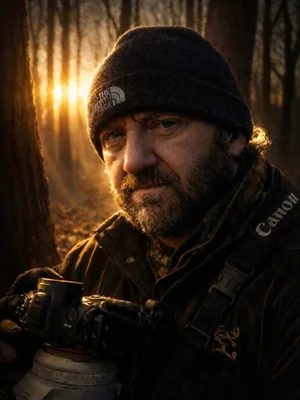
I’ve photographed wolves in the wild. I’ve stood beneath the Tetons watching the first light of morning crawl down those mountains. I’ve wandered through old towns, explored forgotten places, watched storms roll across landscapes, and spent more hours in the field than I could ever begin to count.
I’ve been cold, wet, exhausted, frustrated, injured, and occasionally scared out of my damn mind. And I’ve loved it. Even the miserable parts. Well, most of them. There have been a few mornings when I would’ve happily traded my camera for a warm bed and a decent breakfast.
But those experiences are part of who I am. They’re part of my photography. When I look at one of my images, I don’t just see a photograph. I remember the day. I remember what it took to get there. I remember what was happening around me. Sometimes I remember exactly what I was thinking when I pressed the shutter.
And sometimes those images bring back things that have absolutely nothing to do with photography. Memories, people, places, different chapters of my life.
That’s the part artificial intelligence will never have. It can generate an image of a mountain, but it has never climbed one. It can generate a photograph of a wolf, but it has never sat in the freezing cold, heart pounding, watching one move through the timber. It can write a song about heartbreak, but it has never had its heart broken. It can produce something that looks or sounds like art, but it has never lived the life behind it.
And to me, that matters.
Maybe it doesn’t matter to everyone. Maybe some people only care about the finished product. Maybe the future really is going to be filled with generated photographs, generated songs, generated movies, and generated everything else. Maybe convenience and cost will win.
But I hope not. God, I hope not.
I think we’re standing at a crossroads, and I don’t think enough people are stopping to consider where we’re headed. We’ve spent centuries celebrating human creativity. The ability to take an idea, an emotion, a memory, or an experience and turn it into something another person can see, hear, or feel.
Art has always been one of the ways we understand each other. A photograph can show someone a world they’ve never seen. A song can put words to feelings someone has never been able to explain. A painting can capture an emotion that no sentence ever could. And none of that requires perfection. In fact, sometimes the imperfections are what make it beautiful.
The slightly imperfect note in a singer’s voice. The grain in an old photograph. The brushstroke that isn’t perfectly straight. The human fingerprints left behind in the work. Those aren’t always flaws. Sometimes they’re the very things that give art its soul.
And now we’re building technology designed to eliminate those imperfections, imitate those emotions, and produce endless amounts of content at the push of a button. Faster, cheaper, easier.
But is easier always better? Is faster always progress? And at what point do we stop asking what technology can do and start asking what we actually want it to do? Because just because we can replace something doesn’t mean we should. Especially when that something is a piece of what makes us human.
I don’t know what the future holds for photography. I don’t know how many more clients will decide that generated images are good enough. I don’t know how difficult it’s going to become for musicians, photographers, and other artists to make a living doing what they love.
And I’m not going to pretend that doesn’t concern me. It does. Deeply. I’ve invested too much of my life into this not to care.
But I do know one thing. I’m going to keep picking up my camera. I’m going to keep driving those ridiculous miles. I’m going to keep getting up before the sun, freezing my ass off, chasing light, waiting on wildlife, and coming home with aching bones and memory cards full of photographs.
I’m going to keep spending hours editing images that most people will look at for three seconds before scrolling on. Because that’s what I love. That’s what I’ve spent years learning to do. And that’s part of who I am.
I’m not interested in pretending I stood somewhere I didn’t. I’m not interested in generating experiences I never had. And I’m certainly not interested in trading the things that make photography meaningful to me for the convenience of typing a sentence into a computer.
I want the dirt on my boots, the miles on my truck, the cold air in my lungs, the sound of the shutter, and the excitement of knowing I just captured something special. Even if nobody else ever sees it. Because at the end of the day, photography has never been just about the photograph for me. It’s about everything that goes into making it.
And I suspect a lot of musicians, painters, writers, and other artists feel exactly the same way. We don’t create simply because we need something to show people. We create because there’s something inside us that needs to come out. Something we’ve experienced, something we’ve felt, something we’ve lived. Sometimes it’s joy. Sometimes it’s pain. Sometimes it’s something we can’t even put into words. And sometimes creating something is the only way we know how to make sense of it all.
So use AI to make our lives easier. Help us cure diseases, solve problems, and eliminate the mind-numbing tasks nobody wants to do. There’s plenty of work for it out there.
But for the love of God, leave a little room for the human imagination. Leave a little room for the struggle, the mistakes, the passion, and the years spent learning something the hard way. Leave a little room for the people who actually live the stories behind the art.
Because if we eventually hand over every part of human creativity to a machine, I have to wonder what the hell we’re going to have left that’s truly ours.
And perhaps the saddest part of all is that we may not realize what we’ve lost until it’s gone.
I’ll keep doing it the hard way. Because to me, the experience, the struggle, and the passion behind the art are worth just as much as the finished piece. Maybe even more.
— Brian Venghous